Home / Monthly giving vs. one-time donation: which helps Ukrainian children more?
Monthly giving vs. one-time donation: which helps Ukrainian children more?
Both one-time and monthly donations directly help Ukrainian children. The real difference is not which gift matters more – it is what kind of support a charity can plan around.
12 min
Content
Key takeaways
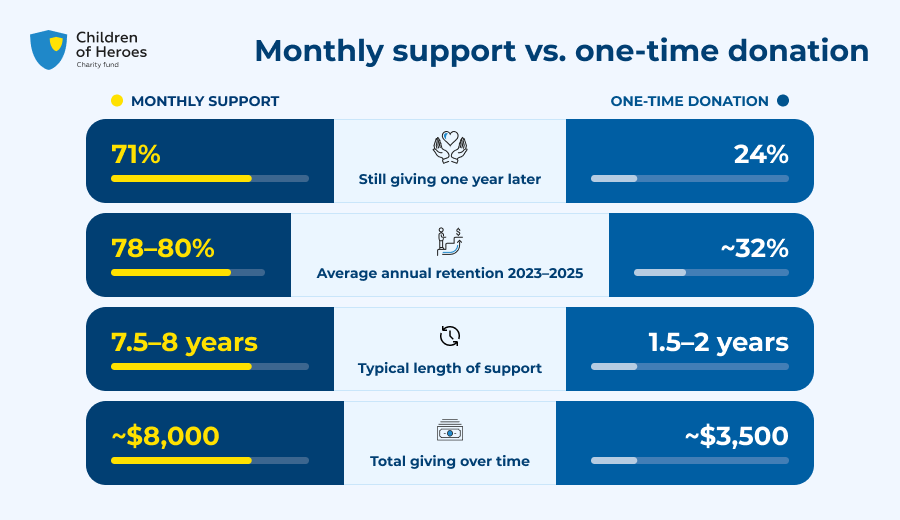
71% of monthly supporters are still giving a year after their first gift; only 24% of new one-time supporters return
A typical monthly supporter keeps giving for 7.5–8 years; a one-time supporter, 1.5–2
A recurring supporter gives about $8,000 over a lifetime versus roughly $3,500 for a one-time supporter – despite far smaller installments
Monthly giving enables long-term planning and stable support
One-time gifts are still valuable, often larger, and best for urgent needs and dedicated fundraisers
You want to donate to Ukraine children who lost a parent in the war, and the donation form asks you to choose: monthly giving or a one-time donation? The harder question underneath it is which format does more for a child in the long run – and the data on that is clearer than most supporters expect.
How a one-time donation helps Ukrainian children
A one-time donation arrives fast, and it is usually the larger gift. When people respond to a specific event – a missile strike, a family left without income, a school year starting – they tend to give more in a single transaction than they would commit to monthly. That immediacy is the format’s strength.
Where a single gift does its best work
One-time gifts fit targeted appeals best. At Children of Heroes Charity Fund, dedicated fundraisers collect for one defined need – a course of medical treatment, laptops for a group of students, psychologist sessions for children in one region – and close once supporters reach the goal. A single gift to a fundraiser like that has a clear job and a visible finish line.
Speed matters in this work. When a family loses a father at the front, its income can disappear in a day, while the rent, the pharmacy bill, and the school year do not wait. One-time gifts are what let a Ukraine children charity respond that same week – cover the urgent expense, stabilize the household, and only then plan the next stage.
The catch: most one-time supporters never return
The format has one structural weakness, and it is not the supporter’s fault. Most people who give once never give to that organization again. M+R Benchmarks 2026 found that only 24% of new supporters returned to make a second gift. An organization can spend a one-time gift well, but it cannot plan long-term programs on gifts it does not know are coming.
How monthly giving helps Ukrainian children more over time
Monthly giving wins on one measure that matters most for children who need support for years, not weeks: it keeps arriving. The numbers behind that claim come from aggregated industry studies across thousands of nonprofits, not from any one organization’s marketing.
Who is still giving a year later
Across the sector, 71% of monthly supporters are still active a full year after they start, and a little more than half of monthly gifts are still running after two years. Compare that with the 24% of one-time supporters who ever come back. Neon One’s Recurring Donor Report 2026 draws the same picture over a longer horizon: recurring-gift retention held between 78% and 80% from 2023 to 2025, while one-time retention slid to 32.41%. A typical monthly supporter stays with an organization for 7.5–8 years; a typical one-time supporter, 1.5–2 years.
Time compounds into money. Givebutter puts the lifetime value of a recurring supporter at close to $8,000, against roughly $3,500 for a one-time supporter – even though the average monthly installment is far smaller than the average single gift. The average first recurring gift across the sector is $84.38, with a median of $30. Modest monthly amounts, sustained for years, outweigh a single generous transaction.
Why predictable income changes what an organization can promise
For an organization, the difference shows up in what it can commit to. Long-term support for a child who lost a parent is built in stages: psychological stabilization comes first, and educational re-entry depends on it; case management then runs through to age 19. A child midway through individual sessions needs the same psychologist in month eight and the same tutor through the whole school year. Running those programs on one-time gifts alone is like running a household on occasional bonuses instead of a salary – you can survive, but you cannot sign a lease. Monthly giving is the salary. That is why it already accounts for 27% of all online revenue across the nonprofit sector – and 37% at the largest organizations, which can afford to plan furthest ahead.
Supporters sometimes hesitate here, reasoning that $15 a month is too small to matter next to a $200 single gift. The retention data says the opposite. The $200 supporter most likely gives once and disappears from the ledger; the $15 supporter, statistically, is still there in year three, and by then has given more – with an organization able to plan a child’s next stage around every installment.
Support children who lost parents to the war
A monthly gift keeps psychological stabilization, schooling, and medical care running as long as needed
Monthly giving vs. one-time donation: side-by-side comparison
Neither format is inherently better – they serve different purposes. Here’s how they compare across the key measures tracked by industry data. The pattern is consistent: one-time gifts move faster, while monthly gifts go further.
Criterion
Monthly giving
One-time donation
Income predictability for the organization
High – known amount arrives every month
Low – depends on appeals and events
Supporters still giving after 12 months
71%
24% of new supporters return
Typical length of support
7.5–8 years
1.5–2 years
Estimated lifetime value per supporter
~$8,000
~$3,500
Typical first gift
$84.38 average; $30 median
Usually larger as a single amount
Effort for the supporter
Set up once, runs automatically, cancel anytime
One decision, no ongoing commitment
Best suited for
Long-term programs
Urgent needs
What your monthly gift funds at Children of Heroes
The monthly donor vs. one-time donor comparison turns concrete when you look at what recurring money pays for. Children of Heroes Charity Fund provides comprehensive, long-term support until age 19 for children who lost one or both parents to Russia’s war against Ukraine, and every part of that support is built to run for years, not weeks:
Psychological support and socialisation – individual and group sessions with psychologists, camps, and activities that help children cope with loss, build resilience, connect with their peers, and make friends.
Family Case Management Program – an individual support plan for every child, reviewed and adjusted as their circumstances and needs change.
Education and development – tutoring, language courses, IT training, creative workshops, and career guidance, as well as devices needed for learning.
Humanitarian aid – baby care products, hygiene essentials, food, seasonal clothing and footwear, holiday gifts, and other everyday necessities.
Medical care – access to medical consultations, examinations, treatment, eye care, and insurance, as well as vitamins and first-aid kits.
The Children of Heroes Fund works in partnership with the parents and guardians raising these children. Parents and guardians make decisions about the child’s care, while the Fund’s specialists help identify current needs and arrange the necessary support.
Monthly donations go into a shared fund that supports children and their families. This means that even a small regular contribution becomes part of reliable, ongoing support that the Fund can plan for over the long term.
You can read more about how charitable donations are allocated in this article.
Which option is right for you?
If you are deciding how to help the children of Ukraine, the honest answer to “is it better to donate monthly or one-time” depends on three things: your budget’s stability, the kind of connection you want, and what you are responding to.
When a one-time donation makes sense
A one-time donation is a good option if you want to respond to a specific event or support adedicated fundraiser. It’s a convenient choice if you don’t want to make a regular commitment but still want to help when support is needed most.
When monthly support makes sense
If you can regularly set aside a fixed amount – even $10 or $20 – consider monthly support. Recurring donations help us provide comprehensive support to children who have lost a parent and be there for them as they grow into adulthood.
Combine different ways of giving
You don’t have to choose between monthly support and one-time donations. You can support children with a small monthly contribution and, when you can, make additional donations to urgent or dedicated fundraisers.
Setting up a monthly gift takes about two minutes, whether it is your first gift to the Fund or you have given once before.
1. Open the monthly support page
Go to Monthly support for children. The donation form lets you choose any amount and set the frequency to monthly.
2. Pick an amount that survives your budget review
Choose a figure you will not notice in a hard month. The median first recurring gift across the sector is $30; consistency matters more than size.
3. Manage or cancel anytime
In your account, you can change your donation amount, pause, or cancel your monthly donations at any time. You can also view your payment history and see the impact of your support.
If you have any difficulties, the Foundation’s team can help you change or cancel your monthly support upon request.
If you prefer to make one-time donations, you can also make a one-time donation through the Foundation’s website.
FAQ
Can I cancel my monthly donation?
Yes. You can change the amount, pause, or cancel your monthly donation in your account at any time. Your support stops with the next billing cycle.
How much should I give monthly to make a meaningful impact?
Any amount you can sustain is meaningful, because reliability is what monthly giving adds. Across the nonprofit sector, the median first recurring gift is $30 a month, and pooled recurring gifts are what let an organization commit to a child’s psychologist sessions or schooling months in advance. A $15 gift that runs for two years does more than a $100 gift given once – the lifetime-value figures above bear this out.
What does my monthly donation to Children of Heroes fund?
Monthly gifts fund the Fund’s long-term programs for children who lost a parent to the war: psychological stabilization, case management, educational pathways (supplies, tutoring, courses), and humanitarian and medical assistance, through to age 19. Because recurring income is predictable, it goes to the multi-year parts of that work first. Details are on the monthly support page.
Is a one-time donation still valuable if I can’t commit to monthly giving?
Yes. A one-time donation is real support, and single gifts are often larger than monthly installments. One-time gifts are especially effective in dedicated fundraisers for specific needs, from medical treatment to laptops for school. Give in the format your budget can honestly support.
Are donations to Children of Heroes tax-deductible?
In many countries, yes. In the United States, donations are tax-deductible through the Children of Heroes Foundation’s registered 501(c)(3) entity. In the Netherlands, donations are deductible through the Dutch ANBI entity. The guide on how to choose a legitimate Ukraine children’s charity also explains how to check a charity’s registration and tax status. For guidance specific to your country, consult a tax advisor.