

Education in Ukraine during wartime: challenges and support for children
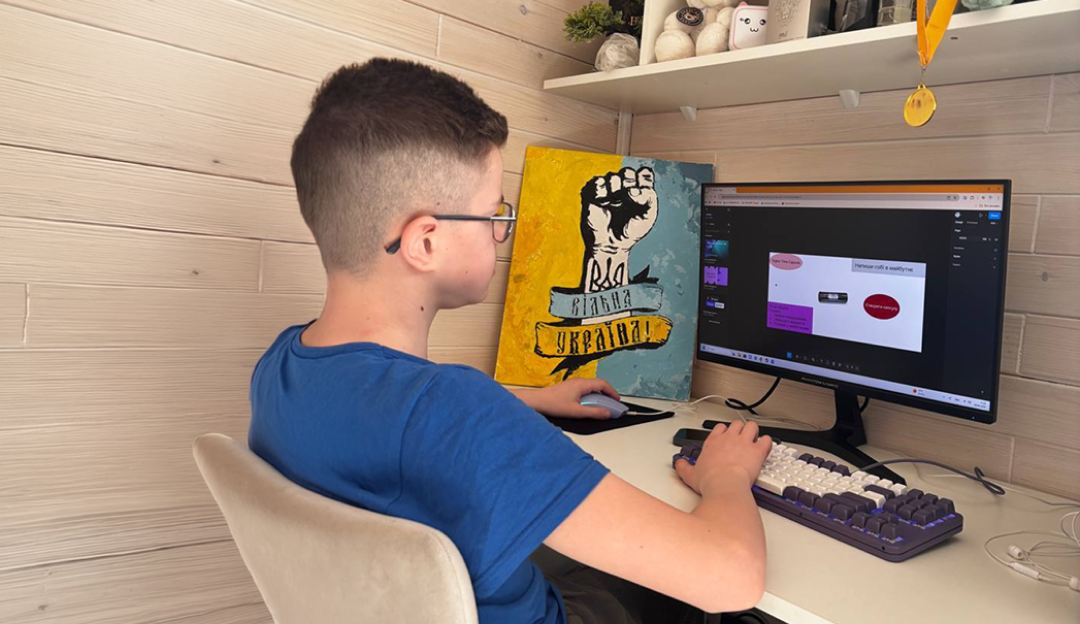
Key takeaways
- Around 4.6 million children in Ukraine face barriers to education.
- Children who have lost one or both parents face additional emotional pressure that affects focus, school attendance, and social interaction.
- Organizations such as the Children of Heroes Charity Fund provide long-term, personalized education support, including tutoring, language learning, devices, and university preparation.
- In 2025, Children of Heroes supported 4,188 children through education programs, up from 3,423 in 2024.
More than four years into Russia’s full-scale invasion, education in Ukraine has changed significantly. For many children, a typical school day may include moving to a shelter during alerts, attending lessons from basements or underground stations, or learning online instead of going to a classroom. For children who have lost one or both parents, these challenges are even harder to manage.
The Ukrainian government, international partners, and educational institutions continue to respond to these challenges. Nonprofit organizations also play an important role, including the Children of Heroes Charity Fund. This article looks at how the organization supports children in accessing education and continuing their learning despite ongoing challenges.
Support children today
Education during wartime: statistics
The disruption to education in Ukraine is large in scale. During the 2024–2025 school year, air raid alerts caused children to miss about one in five lessons. In some front-line regions, students missed more than 40% of classes.
More than 3 million children have been displaced, and nearly 1 million are studying fully online. According to UNICEF, Ukrainian students have experienced learning losses equivalent to two years in reading and one year in math compared to pre-war levels.
The impact on mental well-being also affects learning. Ongoing stress, loss, and disrupted routines make it harder for children to concentrate, even when they attend classes.
Below are additional statistics from UNICEF, Save the Children, and the World Bank’s RDNA4 report.
Metric | Figure |
Children facing educational barriers (2025) | ~4.6 million |
Children studying fully online | ~1 million |
Educational facilities damaged or destroyed | ~2,800 |
Facilities damaged or destroyed in 2025 alone | 340+ |
Share of educational infrastructure damaged (2022–2024) | 10%+ |
Estimated repair cost | $13.4 billion |
Children showing psychosocial distress (conflict-affected areas) | 43% |
Preschoolers in frontline regions with signs of emotional distress | 83% |
Children of Heroes Charity Fund: what they do and who they help
The Children of Heroes Charity Fund was founded in March 2022, shortly after Russia’s full-scale invasion of Ukraine. The organization supports children who have lost one or both parents due to the war. Support continues until each child turns 18 and extends into early adulthood.
The Fund operates seven core programs:
- Psychology and socialization
- Education and development
- Medical care
- Humanitarian aid
- Case management
- Family Helpers
- Holiday presents
Education is one of the priority areas. Based on the planned 2026 budget, it accounts for 18% of total funding, compared to 25% for psychology and socialization and 22% for the Family Helpers program.
Education and development program: overview
The Fund’s education program is based on a clear idea: children need structured support to continue learning and developing. Education creates structure, builds confidence, and shifts a child’s focus from loss to possibility.
The Fund offers separate programs for children ages 4 to 17, covering a wide range of needs:
Program | Age range | Focus |
School readiness | 5–7 years | Preparing for the transition to school |
Early childhood development | 4–6 years | Speech, cognition, and social skills |
Online tutoring (math, Ukrainian language, science) | 6–16 years | Catching up on core subjects |
Foreign language learning | 6–18 years | English and other languages |
IT and programming | 7–18 years | Coding, design, digital skills |
STEM courses | Various | Engineering, technology, critical thinking |
Arts and creative activities | 6–12 years | Expression, confidence, emotional healing |
University entrance preparation | 15–17 years | Exam prep, career guidance |
Study abroad support | 14–17 years | UK summer schools, US university guidance |
Career orientation | 14–16 years | Helping teens explore future paths |
Each child’s academic progress is monitored regularly. Providers conduct knowledge screenings every quarter and a full assessment every six months.
2025 by the numbers
In 2025, the Fund’s education program supported 4,188 children, up from 3,423 in 2024 – an increase of nearly 23%.
Program reach in 2025
Program area | Children reached |
Foreign language learning | 1,701 |
Online tutoring (school subjects) | 1,503 |
School supplies (stationery kits) | 4,755 |
Learning devices (laptops, tablets) | 1,687 |
Extracurricular activities and creative programs | 1,817 |
Early childhood programs | 601 |
University entrance preparation | 320 |
Arts and creative skills | 315 |
IT and programming | 263 |
STEM courses | 221 |
Career guidance (proforientation) | 84 |
Private and preschool institutions | 70 |
Study abroad – UK summer schools | 60 |
Study abroad – US university visit | 6 |
The program also supports guardians and caregivers. In 2025, more than 100 guardians attended career counseling webinars, and 5 were employed as teachers at a partner online school. Others completed retraining courses in areas such as HR, accounting, IT, and logistics.
How children benefit from the education program: real stories
Behind the numbers are families adapting to difficult circumstances.
One mother shared how her daughter started English lessons through the Fund in the spring. Within a few months, she became more confident: reading books in English, watching films in the original language, and thinking about studying abroad. “She began to believe in possibilities that once seemed out of reach,” the mother said. “This learning became an important step in shaping her future.”
Another family from the Kirovohrad region lost their father. Two children remained – Dima, who loves football and dreams of playing professionally, and Nastia, who is interested in IT and programming. Through the Fund, Nastia joined coding courses and later earned her first income by designing business cards. “She is very engaged in learning,” her mother wrote. “We are grateful for the educational support.”
One teenager who completed a front-end development course described the experience: “I started with a basic interest in the topic. During the course, teachers explained everything clearly, and support was always available. I learned to build websites, worked with CSS and JavaScript, and improved my soft skills. This course changed how I see my abilities.”
A mother of a boy named Makar, whose school had been closed since the start of the full-scale invasion, shared: “Makar has strong academic results, and we are grateful for the support that helped him maintain them, including in English.”
Conclusion
The war in Ukraine has created a large-scale disruption to education, affecting millions of children Consistent access to education helps children maintain progress, build skills, and prepare for independent adult life.
Organizations such as the Children of Heroes Charity Fund provide long-term, personalized support that adapts to each child’s situation. As international attention shifts, this type of continuous support becomes more limited, increasing the role of local organizations in maintaining access to education.
If you want to help Ukrainian children keep learning, there are a few ways to get involved:
- Make a one-time donation to support educational initiatives.
- Become a monthly supporter so children have stable, ongoing access to what they need.
- Start a fundraiser and invite your community to contribute.
- Spread the word about the Fund because raising awareness matters more than ever as global attention shifts.
FAQ
How has the war in Ukraine affected children’s education?
The war has disrupted schooling for around 4.6 million children. Schools have been damaged or closed, many families have relocated, and air raid alerts regularly interrupt lessons. As a result, many students have fallen behind, with learning gaps of up to two years compared to pre-war levels.
How many schools in Ukraine have been damaged or destroyed?
As of late 2025, the UN has verified around 2,800 schools damaged or destroyed since February 2022. More than 340 facilities were affected in 2025 alone. The actual number may be higher, as these figures include only verified cases.
What is the Children of Heroes Charity Fund?
Children of Heroes is a nonprofit organization founded in March 2022. It supports children in Ukraine who have lost one or both parents due to the war, providing long-term assistance through seven core programs such as education, psychological support, medical care, and humanitarian aid. The organization is registered as a 501(c)(3) charity in the United States and holds ANBI status in the Netherlands.
What kinds of educational support does Children of Heroes provide?
The Fund offers a wide range of programs for children ages 4 to 17, including online tutoring, foreign language classes, IT and programming courses, STEM education, arts and creative activities, university entrance preparation, and study-abroad opportunities in the UK and US. They also provide learning devices and school supplies.
How many children did Children of Heroes support through education in 2025?
In 2025, the Fund’s education program reached 4,188 children – up from 3,423 in 2024. Over 4,755 children also received school supply kits, and 1,687 children received laptops or tablets for online learning.
How does Children of Heroes ensure quality of education support?
The Fund tracks children’s academic progress through quarterly knowledge screenings and full assessments every six months. In 2025, results showed that the majority of children tested at high proficiency levels in English and math.
Is Children of Heroes a trustworthy organization to donate to?
Yes. The fund holds a Platinum Seal of Transparency from Candid (formerly GuideStar), an Effective Organization badge from GlobalGiving, and is a member of Eurochild. It publishes regular monthly and annual reports. US donations are tax-deductible.
What can I do to help Ukrainian children access education?
You can donate to organizations like Children of Heroes – either as a one-time gift or as a monthly supporter. You can also start a fundraiser, spread awareness on social media, or share this article with people who want to understand what’s happening on the ground.
Why is it important to support local Ukrainian charities specifically?
As global attention moves to other crises, international funding for Ukraine tends to decline. Local organizations like Children of Heroes maintain direct relationships with families and children, providing consistent, personalized support over many years.