

Comprehensive family support as a standard for Ukraine’s recovery: Children of Heroes Charity Fund’s experience recommended for URC 2026
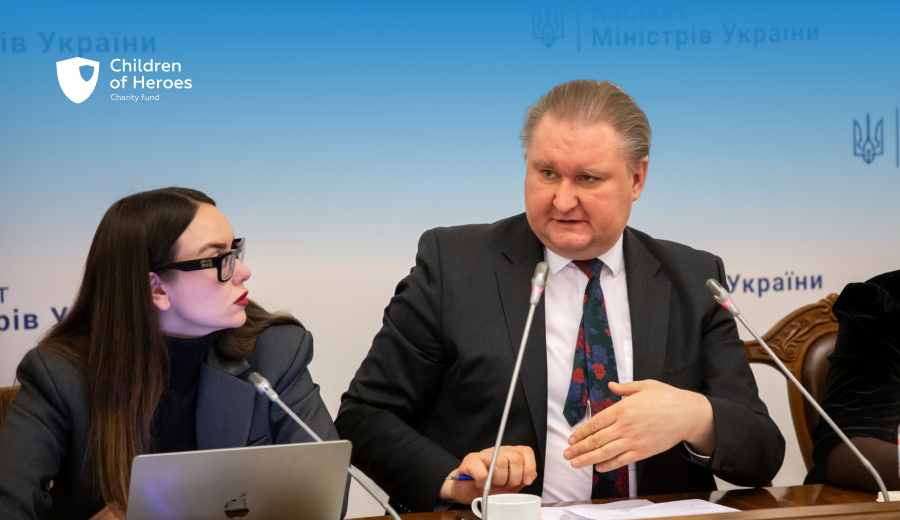
In February, representatives of the Children of Heroes Charity Fund attended a meeting with Taras Kachka, Deputy Prime Minister for European and Euro-Atlantic Integration of Ukraine, Kateryna Levchenko, Government Commissioner for Gender Policy, and civil society organizations. The meeting became an important step in Ukraine’s joint preparations for the Ukraine Recovery Conference (URC 2026) and the UN Commission on the Status of Women (CSW 2026).
During the event, we presented our comprehensive support model for children who have lost one or both parents due to the war, as well as for their mothers. This approach proves its effectiveness every day in our work with thousands of families, where women, while living through their own loss, are simultaneously mothers, the sole breadwinners, and the child’s emotional anchor.
Ninety-eight percent of children supported by the Fund have lost their father, so supporting mothers is a necessary condition for a family’s recovery, not an optional add-on. Our practice clearly shows that when a mother is in a constant state of anxiety, she has no capacity left to work, study, plan, invest, or participate in economic life. Psychological stabilisation of the adult, together with comprehensive support for the child, helps the family move from survival mode to growth.
During the war, women remain Ukraine’s economically active population. Investing in their stabilisation and recovery is essential; otherwise, we lose the country’s economic potential. That is why we also shared our experience in teaching financial literacy to mothers. This is one of the most in-demand support areas, and it works best when paired with psychological support and ongoing case management.
In recent years, we have observed a significant increase in requests for psychological help. The most common concerns include anxiety disorders, sleep and concentration problems, emotional instability, difficulties with adaptation, decreased motivation, and psychosomatic symptoms.
Today, the Fund’s work involves 37 specialists with psychotherapeutic training and experience working with trauma and loss. The average professional experience of our psychotherapists exceeds 10 years.
Our psychological support program includes individual sessions with specialists, peer support groups, art therapy, psychoeducation lectures for families, and camps with an integrated psychological support program.
We believe that comprehensive family support must become one of the standards of Ukraine’s recovery and part of the solutions the country presents to international platforms in preparation for URC 2026 and CSW 2026. This is a real Ukrainian best practice worth showcasing internationally as an example of investing in human capital, a gender-sensitive approach to recovery, and a mature social policy aligned with European standards.
We invite partners to join us in expanding the psychological support program in 2026, so more children and mothers can receive stable, long-term support and return to learning, work, and plans for the future.
